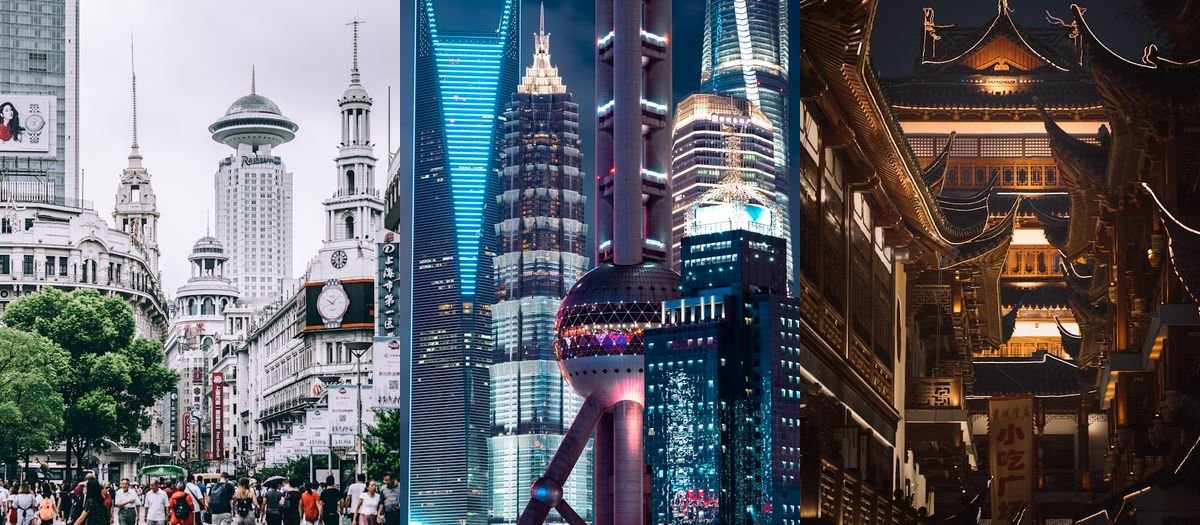
1. Which Neighbourhood to Stay In
Shanghai spans 6,340 km² with 16 districts — but as a traveller, you only need to focus on five. The city is split by the Huangpu River into two halves: Puxi (west, historic) and Pudong (east, futuristic). Most travellers stay in Puxi for walkability and character.
Based on 1,200+ accommodation reviews filtered to 8.5+ ratings on Booking.com and Google Maps, here's how the major areas compare:
| Area |
Best For |
Avg. Mid-Range Hotel |
Metro Access |
Verdict |
| The Bund / Nanjing Road |
First-timers, views |
$80–$160 / night |
Excellent — Lines 2 & 10 |
Best All-Round |
| French Concession |
Cafés, boutiques, charm |
$70–$140 / night |
Good — Lines 1, 7, 10 |
Best Atmosphere |
| Jing'an |
Shopping, modern city life |
$90–$180 / night |
Excellent — Lines 2, 7, 12, 13 |
Central & Convenient |
| Old City (Yu Garden) |
Culture, history, bazaars |
$50–$100 / night |
Good — Lines 10, 8 |
Best Value |
| Pudong (Lujiazui) |
Business, luxury hotels |
$150–$350 / night |
Excellent — Line 2 |
Luxury Pick |
Research verdict: For first-time visitors, the Bund / Nanjing Road area offers unbeatable skyline views and walking access to half of Shanghai's highlights. The French Concession is the better pick if you prefer tree-lined streets, independent cafés and a slower pace — it's Shanghai at its most charming.
"
Stayed near Fuxing Park in the French Concession for 5 nights. The plane trees, the morning tai chi groups, the tiny coffee shops on every lane — it felt like a different city from the skyscraper Shanghai everyone talks about. Easy metro to everywhere too.
— TripAdvisor user UrbanExplorer_KL, Shanghai review (verified stay, March 2026)
2. 3-Day Shanghai Itinerary (No Backtracking)
This route groups attractions by geography — each day covers a compact cluster so you minimise metro transfers and maximise time on the ground. All metro line numbers and exit gates are included.
The Bund (Waitan) — Morning Walk
Start early to catch the Bund at its quietest. The 1.5km promenade from Waibaidu Bridge to Yan'an Road gives you 26 historic colonial buildings on one side and Pudong's futuristic skyline on the other. Allow 60–90 minutes.
💡 Free. Best photos: the promenade midpoint, looking east toward the Pearl Tower at sunrise.
Nanjing Road East — Pedestrian Street
Walk 5 minutes west from the Bund. China's most famous shopping street: 5.5km of stores, food stalls and people-watching. The pedestrianised section (East Nanjing Road) runs 1.6km to People's Square.
💡 Try shengjianbao (pan-fried pork buns) at Yang's Dumplings near the People's Square end. ¥15–¥20 for 4.
French Concession — Lunch & Explore
Metro Line 10 from East Nanjing Road to Shanghai Library (Exit 2). Spend the afternoon wandering tree-lined streets: Wukang Road, Anfu Road and Fuxing Road are the prettiest stretches. Stop for coffee at Manner or %Arabica on Wukang Road.
🚇 Line 10 from East Nanjing Road to Shanghai Library — 4 stops, 10 min, ¥4
Tianzifang — Evening Lanes
Walk 15 minutes south or take Line 9 one stop to Dapuqiao. Tianzifang is a maze of Shikumen lane houses turned into artisan shops, bars and galleries. More polished than it was a decade ago, but still a lively evening spot.
💡 Gets crowded after 6pm on weekends. Visit on a weekday for a calmer experience.
Shanghai Tower — Observation Deck
The world's third-tallest building (632m). The 118th-floor observation deck at 546m is the highest in the world. Go early — queues build by 10:30am. Pre-book tickets online for fastest entry.
🚇 Line 2 to Lujiazui — Exit 6, walk 8 min.
💡 Ticket: ¥180 online / ¥200 at the door. The Shanghai Tower is a better experience than the neighbouring Pearl Tower — higher, less crowded, better views.
Yu Garden & Old City Bazaar
Metro Line 2 back to East Nanjing Road, transfer to Line 10, get off at Yuyuan Garden (Exit 1). The 16th-century Ming-dynasty garden is an exquisite 2-hectare maze of rockeries, pavilions and carp ponds. The surrounding bazaar sells everything from tea to crafts.
🚇 Line 2 from Lujiazui to East Nanjing Road, transfer to Line 10 to Yuyuan Garden — 3 stops total, 15 min, ¥5
💡 Garden entry: ¥40. Skip the overpriced bazaar restaurants — eat at the Nanxiang Steamed Bun Restaurant inside the garden complex instead. ¥35 for a bamboo steamer of xiaolongbao.
Huangpu River Cruise
Walk 10 minutes north to the Shiliupu (16 Pu) ferry terminal. A 45-minute river cruise gives you the best perspective on old vs. new Shanghai — colonial Bund on one side, neon Pudong on the other. Best taken in the late afternoon so you catch sunset.
💡 Ferry ticket: ¥2 for the standard ferry, ¥120–¥150 for the tourist cruise with commentary. The standard ferry is the same view for 1/60th the price.
Bund Night View & Dinner
Return to the Bund after dark — the Pudong skyline light show runs every evening (7pm–10pm in summer, 6pm–9pm in winter). Walk south along the promenade to the South Bund for quieter viewpoints. Dinner at one of the mid-range Shanghainese restaurants on Guangdong Road.
💡 Dinner budget: ¥80–¥150 per person for excellent Shanghainese food. Try the red-braised pork (hongshao rou) and drunken chicken.
Day 3 suggestion: Morning at the Shanghai Museum (free, Line 1/2/8 to People's Square, allow 2–3 hours). Afternoon split between M50 art district (free contemporary galleries in a former textile mill, Line 3/4 to Zhongtan Road) and a walk along Suzhou Creek. Evening: craft cocktail bar hop in the French Concession — Speak Low and Sober Company are the top-rated.
3. Getting Around Shanghai
Shanghai's public transport is one of the most extensive in the world — 19 metro lines, 500+ stations, and trains every 2–3 minutes. For visitors, the system is remarkably easy: all signs and announcements are bilingual (Chinese + English).
Shanghai Metro
The metro is the fastest and most reliable way to get around. Fares are distance-based: ¥3 for the first 6km, rising to ¥9 for longer trips. Most tourist trips cost ¥3–¥6.
✅
Shanghai Public Transport Card: Available at any metro station service counter (¥20 deposit, refundable). Works on metro, buses, ferries, taxis and even some convenience stores. Load ¥50–¥100 for a 3–5 day trip.
✅
Alipay Transport QR Code: If you have Alipay set up (see Practical Info below), scan the QR code at metro gates. More convenient than a physical card, but requires a data connection.
✅
Maglev Train: From Pudong International Airport (PVG) to Longyang Road. 430 km/h, 7 minutes. ¥50 single / ¥80 round-trip. Connects to Metro Lines 2, 7, 16, 18 at Longyang Road.
✅
Didi (Chinese Uber): The most practical taxi alternative. Fares are cheap by Western standards: ¥25–¥60 for most trips within the city centre. Use the mini-app inside Alipay or WeChat — no separate app download needed.
❌
Taxis: Flag-down starts at ¥14 (day) / ¥18 (night). Drivers rarely speak English — always have your destination written in Chinese characters. Didi is easier in every way.
"
The metro is genuinely excellent — clean, air-conditioned, security-checked, and absurdly cheap. We went from the Bund to Qibao water town (25km) for ¥5. Download the MetroMan app before you go — it works offline and gives you the exact exit number to take for each attraction.
— Google Maps user S.Chen_Adventures, Shanghai review (verified, October 2025)
4. Practical Info: Money, Apps & Safety
Money & Payments
📱
Shanghai is nearly cashless — 90%+ of transactions happen via Alipay or WeChat Pay. Street food stalls, wet markets, even beggars accept QR code payments. Set up Alipay TourPass before you arrive (link your international card — Visa/MC accepted).
💴
Carry ¥200–¥500 in cash as backup — some older vendors and very small shops still prefer it. ATMs at Bank of China and ICBC accept international cards reliably.
💳
Visa / Mastercard accepted in hotels, department stores and international chains. Not accepted in most local restaurants, convenience stores or markets.
Essential Apps
📶
Alipay: Payment + Didi ride-hailing + metro QR code + bike rental all in one app. The single most useful app for any China trip. Set up before you leave home.
🗺️
Apple Maps / Baidu Maps: Google Maps works but is less reliable for China. Apple Maps uses local data and works well. For Android, download Baidu Maps (Chinese only, but the navigation is visual enough to follow).
🔤
Pleco or Google Translate: Pleco is the best offline Chinese-English dictionary. Google Translate's camera mode works for menus and signs, but needs a VPN to function in China.
Internet & VPN
📶
eSIM / Travel SIM: Nihao Mobile and China Unicom offer tourist SIMs (10GB for ¥99, 30 days). eSIM options via Airalo and Nomad work without VPN for most apps. Install your VPN before arriving — the Great Firewall blocks VPN download sites.
🔒
VPN required for: Google, Gmail, WhatsApp, Instagram, Facebook, Twitter, YouTube, Line. Astrill and LetsVPN are the most reliable in China. Set up and test at home before departure.
Safety
Shanghai is one of the safest large cities in the world for travellers. Violent crime against foreigners is extremely rare. The main risks are scams (tea ceremony invitations, "art student" approaches on the Bund) and pickpocketing in dense crowds — standard awareness in tourist areas is all you need. Shanghai Metro has security scanners at every entrance; cooperation is mandatory but takes seconds.
5. Best Time to Visit Shanghai
Shanghai has four distinct seasons with a subtropical monsoon climate. Based on traveller reviews and Shanghai Meteorological Bureau data, here's the seasonal breakdown:
| Season |
Months |
Avg. Temp |
Crowds |
Verdict |
| Spring |
Mar – May |
10°C – 24°C |
Moderate |
Best Season |
| Summer |
Jun – Aug |
25°C – 36°C |
High (domestic tourism) |
Hot & Humid |
| Autumn |
Sep – Nov |
12°C – 25°C |
Moderate |
Also Excellent |
| Winter |
Dec – Feb |
1°C – 8°C |
Low |
Cold but Quiet |
Research verdict: Late March to early May and October to mid-November offer the most comfortable weather — clear skies, daytime temperatures around 18–22°C, and the plane trees of the French Concession at their most beautiful. Avoid the first week of October (Golden Week) when domestic tourism peaks and every attraction has 2-hour queues.
"
Went in late October — perfect 20°C days, blue skies, and the ginkgo trees along the Bund were turning gold. We walked everywhere. Apparently we dodged the summer humidity and the Golden Week madness by about three weeks each side.
— TripAdvisor user NomadSarah_J, Shanghai review (verified stay, October 2025)
Frequently Asked Questions
How do I get from Shanghai Pudong Airport to the city centre?
Three options. Maglev + Metro: Maglev to Longyang Road (¥50, 7–8 min, 431 km/h), then Metro Line 2 to Lujiazui or People’s Square (¥5–10, 20–40 min). Total ¥55–60, 30–55 minutes — fastest and the experience is worth it. Taxi/Didi: ¥150–250 (US$22–35), 45–90 minutes door-to-door — best with luggage. Metro Line 2: ¥7–10, 60–90 minutes — cheapest but 33 stops. After ~22:30, taxi is your only option. Night surcharge: +30% after 23:00.
Do I need a visa to visit Shanghai in 2026?
Most nationalities need a visa. China offers a 6-day (144-hour) transit visa-free policy for 54 countries (including the US, UK, Canada, Australia, Japan, South Korea, and most EU countries) when transiting through Shanghai to a third country. For a direct visit, you need a tourist L visa — apply at a Chinese embassy before travel. Since 2024, 38 European countries, Malaysia, and Australia have received 15–30 day visa-free entry. China’s visa policy is changing rapidly — always verify with your nearest Chinese embassy before booking. All visitors also need to complete a digital arrival card within 24 hours of travel.
How do I pay for things in Shanghai without Chinese apps?
Set up Alipay — link your foreign credit card directly (now supported for international users, no Chinese bank account needed). Apple Pay works for Shanghai Metro. Carry some cash (¥500–1,000) for backup, especially at street food stalls and small vendors where QR payments may be required but not your card. International cards work at hotels, high-end restaurants, and malls but rarely at local eateries or markets. Didi accepts foreign cards for ride-hailing. Download a VPN before arriving — Google, WhatsApp, Instagram, and most Western sites are blocked. An eSIM with data roaming (Airalo, Holafly) bypasses the firewall without a VPN for short trips.
Is the Shanghai Maglev train worth it?
As a transport-only option, a taxi to a Pudong hotel might be faster and similarly priced for 2+ people. But as an experience, it is absolutely worth ¥50. At 431 km/h it is the world’s fastest commercial train — the 7–8 minute ride is genuinely thrilling, and speed displays show real-time velocity. It runs 6:45 AM–9:40 PM. Best strategy: take the Maglev inbound for the experience, then switch to Metro Line 2 at Longyang Road for your final destination. The return trip to the airport is convenient if departing during operating hours.
Can I use Google and WhatsApp in China?
No — without a VPN or eSIM. Google, Gmail, WhatsApp, Instagram, Facebook, Twitter/X, YouTube, and most Western news sites are blocked by the Great Firewall. Install and test a VPN before departing — VPN websites are blocked once you land. Recommended VPNs: Astrill, ExpressVPN, Mullvad (buy a one-month plan, install a backup). The simplest solution for short trips: an eSIM with data roaming (Airalo, Holafly) bypasses the firewall entirely without any VPN setup. If you need a local Chinese SIM for ride-hailing verification, get one at the airport with your passport.