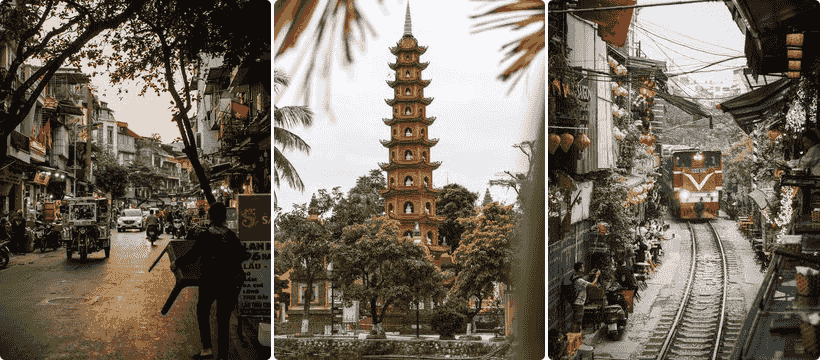
1. Which Area to Stay In
Hanoi is compact by capital city standards — the Old Quarter, Hoan Kiem Lake and the French Quarter form a walkable core of roughly 2km². Choosing where to stay is primarily about atmosphere: the Old Quarter is chaotic, authentic and convenient; the French Quarter is quieter and more spacious; West Lake is removed from the tourist centre but increasingly popular for longer stays. Based on 450+ accommodation reviews filtered to 8.5+ ratings on Booking.com and Google Maps:
| Area |
Best For |
Avg. Mid-Range Hotel |
Getting Around |
Verdict |
| Old Quarter (Hoan Kiem) |
Atmosphere, street food, central access |
$20–$60 / night |
Walk to most sights; Grab for elsewhere |
Best All-Round |
| French Quarter (Hoan Kiem) |
Quieter streets, wider pavements, upmarket dining |
$35–$90 / night |
10 min walk to Hoan Kiem Lake |
Best for Comfort |
| West Lake (Tay Ho) |
Expat cafés, local atmosphere, long stays |
$25–$70 / night |
Grab essential — 4km from Old Quarter |
Best for Long Stays |
| Ba Dinh |
Ho Chi Minh Mausoleum area, quieter |
$18–$50 / night |
Walk to mausoleum; Grab for Old Quarter |
Budget Pick |
Research verdict: The Old Quarter is the undisputed base for first-time visitors — the maze of 36 guild streets, the lake-front walking circuit and the highest concentration of street food and coffee shops in Hanoi are all walkable from any hotel within the quarter. The noise and motorbike traffic are real trade-offs, but a good boutique hotel on a quieter side street resolves most of the congestion issues.
"
Waking up in the Old Quarter and walking to Hoan Kiem Lake at 6am — locals doing tai chi by the water, the red Huc Bridge in the mist, a 10,000 dong coffee from a plastic stool on the pavement — this is why you travel. The chaos of the daytime streets is completely worth it for those quiet mornings.
— TripAdvisor user EarlyRiserParis, Hanoi review (verified stay, November 2025)
2. 3-Day Hanoi Itinerary
Hanoi rewards slow walking. The Old Quarter's street grid is dense and non-linear — every lane reveals something different at different hours. This itinerary is structured to use mornings for the major historical sites (cooler, less crowded) and afternoons for the neighbourhood wandering and food experiences that define the city. Day 3 covers the best day trip from Hanoi.
Hoan Kiem Lake — Morning Circuit
The small lake at the heart of Hanoi's Old Quarter is the city's social centre — at 06:00–07:30 it transforms into an open-air gym, with locals doing tai chi, badminton, aerobics and morning walks around the 1.8km perimeter. The red Huc Bridge leading to Ngoc Son Temple (Jade Mountain Temple, ₫30,000 entry) is at its most photogenic in early morning light before the tourist crowds arrive. The weekend pedestrianised zone around the lake (Friday–Sunday evenings and Saturday–Sunday mornings) is one of Southeast Asia's great urban public spaces.
💡 Ngoc Son Temple: ₫30,000. Most atmospheric at dawn. The lakefront road is closed to vehicles on weekend evenings — the best time for a long walking circuit.
Old Quarter Street Food Breakfast
The 36 guild streets of the Old Quarter — each historically named for the craft or trade sold there (Hang Bac: silver; Hang Gai: silk; Hang Buom: sails) — come alive with street food vendors from 06:00. Essential breakfast stops: Pho Thin (25 Dinh Tien Hoang, Google Maps 4.5+, 3,000+ reviews) for Hanoi-style beef pho; Banh Mi 25 (Hang Ca Street, Michelin Bib Gourmand recognised) for bánh mì. Budget ₫30,000–60,000 for a full breakfast.
💡 Hanoi pho differs from Saigon-style — lighter, clearer broth, fewer toppings. Order "tái" (rare beef) or "chín" (well-done). Most street pho stalls close by 10:00.
Hoa Lo Prison Museum (Hanoi Hilton)
The former French colonial prison — used to detain Vietnamese revolutionaries, and later American POWs during the Vietnam War (dubbed "Hanoi Hilton" by US pilots) — is one of Hanoi's most important historical sites. The museum presents a Vietnamese perspective on both the colonial period and the war. Well-preserved colonial architecture, original cells and artefacts. The contrast between the French-era and American-era exhibitions is striking and thought-provoking.
🛺 Walk 10 min south from Hoan Kiem Lake, or Grab: ₫30,000
💡 Entry: ₫30,000. Allow 1.5 hours. Photography permitted throughout. The English signage is good but an audio guide adds significant context.
Temple of Literature (Van Mieu)
Vietnam's first university, established in 1070 and dedicated to Confucius — a tranquil complex of courtyards, pavilions and 82 stone steles bearing the names of doctoral graduates from the 1400s–1700s. One of Hanoi's best-preserved historical sites and a working cultural venue. The late afternoon light through the ancient banyan trees in the second courtyard is exceptional.
🛺 Grab from Hoa Lo: ₫35,000 (~10 min)
💡 Entry: ₫70,000. Allow 1.5 hours. The site is largest on Sundays with local families — visit on a weekday for quiet contemplation.
Bun Cha Dinner & Bia Hoi Corner
Bun cha — grilled pork patties and belly in sweet fish broth with rice vermicelli and herbs — is Hanoi's signature dish. Bun Cha Huong Lien (24 Le Van Huu, the restaurant visited by Anthony Bourdain and Barack Obama in 2016) is the most famous; Bun Cha 34 Hang Than is the local favourite for value. End the evening at Bia Hoi Corner (intersection of Dinh Liet and Ta Hien streets) — the original Vietnamese fresh draught beer junction, where a glass of bia hoi costs ₫5,000–10,000 and the pavement is packed with plastic stools and locals until midnight.
💡 Bun cha meal: ₫50,000–80,000. Bia hoi: ₫5,000–10,000/glass. The corner is busiest 19:00–22:00 on weekend evenings.
Ho Chi Minh Mausoleum Complex
The presidential Ba Dinh Square complex encompasses the mausoleum where Ho Chi Minh's embalmed body lies in state (Tuesday–Thursday and Saturday–Sunday, 07:30–10:30), the Presidential Palace, Ho Chi Minh's wooden stilt house, the One Pillar Pagoda and the Ho Chi Minh Museum. The mausoleum queue can be long (45–90 min) but moves quickly — strict dress code enforced (no shorts, no sleeveless). Photography of the body is strictly prohibited.
🛺 Grab from Old Quarter: ₫40,000 (~15 min)
💡 Mausoleum: free. Ho Chi Minh Museum: ₫40,000. Complex closed Mondays and Fridays. Arrive by 08:00 for shortest queues. The One Pillar Pagoda (free) is immediately adjacent.
Tran Quoc Pagoda & West Lake Circuit
Tran Quoc Pagoda — a 6th-century Buddhist temple on a small islet in West Lake — is Hanoi's oldest and most photogenic pagoda. The multi-tiered red tower reflected in the lake is one of the city's most compelling architectural images. The surrounding West Lake (Tay Ho) is Hanoi's largest lake, lined with seafood restaurants, lotus farms and the city's best café district (particularly the streets around Xuan Dieu). A lakeside circuit by Grab or bicycle takes 45 minutes.
💡 Tran Quoc Pagoda: free (dress modestly). The Quang An lotus fields near the lake shore bloom June–July — if visiting in season, the short walk through the fields is worthwhile.
Vietnam Museum of Ethnology
The finest museum in Vietnam — covering 54 officially recognised ethnic groups through artefacts, textiles, architectural reconstructions and multimedia exhibits. The outdoor section features full-size traditional houses from different regions. Consistently rated Hanoi's best museum by independent visitors (Google Maps 4.6+, 4,500+ reviews). The English language information is comprehensive and the air conditioning is excellent.
🛺 Grab from West Lake: ₫35,000 (~10 min)
💡 Entry: ₫40,000 adults. Allow 2–2.5 hours. Closed Mondays. The outdoor traditional houses section requires an additional 30 min — don't skip it.
Thang Long Water Puppet Theatre
Water puppetry — a 1,000-year-old Vietnamese art form originating in the Red River Delta — depicts scenes from rural and court life using lacquered wooden puppets manipulated from behind a bamboo screen in a waist-deep pool. The Thang Long Theatre on the shore of Hoan Kiem Lake is the most established venue (founded 1969). Performances: 60 minutes with live traditional music. One of Hanoi's most distinctive cultural experiences and universally recommended by visitors.
💡 Tickets: ₫100,000–200,000. Book 1–2 days in advance for evening shows — they frequently sell out. Photography and video permitted without flash.
Option A: Ninh Binh (Trang An / Tam Coc)
Ninh Binh, 90km south of Hanoi, is often called the "inland Halong Bay" — limestone karst formations rising from rice paddies and river systems navigated by small rowing boats. The Trang An Landscape Complex is UNESCO World Heritage listed; Tam Coc (Three Caves) is the most photogenic river route. Bich Dong Pagoda, set into a cliff face above the rice fields, adds a cultural dimension. The complete circuit takes a full day.
🚌 Bus from My Dinh or Giap Bat Bus Station to Ninh Binh: 2 hrs, ₫80,000–120,000. Organised day tours from Hanoi: ₫350,000–600,000 (includes transport, boat and guide).
💡 Trang An boat trip: ₫250,000 per boat (shared, max 3 people), 3.5 hrs. Tam Coc boat: ₫150,000 per boat. Ninh Binh is significantly less crowded than Halong Bay and more authentic. Best for travellers who prefer scenery without cruise boat infrastructure.
Option B: Halong Bay (1-Day or Overnight Cruise)
Ha Long Bay — 1,969 limestone islands rising from emerald waters in the Gulf of Tonkin — is Vietnam's most iconic natural landscape and a UNESCO World Heritage Site. The bay is 170km from Hanoi (3–3.5 hours by bus). A 1-day tour is possible but rushed; an overnight cruise on a traditional wooden junk boat allows kayaking through caves, swimming and sunrise over the bay. Recommended cruise operators (Google Maps 4.3+, 500+ reviews): Paradise Cruises, Indochina Junk and Bhaya Cruises for mid-range; Nostalgie Cruises for budget.
🚌 Cruise operators include round-trip transport from Hanoi. Day tour: departs 07:30, returns 21:30. Overnight: departs 07:30, returns next day 17:00.
💡 Day tour: ₫900,000–1,500,000 per person. Overnight cruise: ₫2,500,000–5,000,000+ depending on operator quality. Book directly through the cruise company, not street touts. Avoid the lowest-priced operators — overfishing and waste dumping in the bay remain issues at the budget end of the market.
Extension option — Sapa (2 nights): The northern mountain town of Sapa, 350km from Hanoi, is accessible by overnight sleeper train (₫200,000–500,000 each way, 8 hours) or bus. The terraced rice fields of Muong Hoa Valley and the trekking routes through H'mong and Dao minority villages are among Vietnam's most rewarding travel experiences. Best April–June and September–November — fog is heavy outside these windows.
3. Getting Around Hanoi
Hanoi has no tourist-accessible metro covering the key sightseeing areas (the new Metro Line 3 extension opened in 2024 but serves mainly suburban commuters). Getting around the city means choosing between Grab, xe om (motorbike taxi), cyclo, city bus and taxis. For most visitors, Grab handles 90% of transport needs.
Grab (Ride-Hailing)
✅
Grab Car: Fixed price, air-conditioned, reliable. Most journeys within the Old Quarter and central Hanoi: ₫30,000–80,000. Airport (Noi Bai) to Old Quarter: ₫200,000–280,000 (45–60 min depending on traffic). Surge pricing applies during peak hours.
✅
Grab Bike: Fastest option for short trips within the Old Quarter and central areas. ₫15,000–40,000 for most local journeys. Significantly faster than cars through Old Quarter traffic. Helmets provided — use them.
✅
Cyclo (xích lô): Three-wheeled bicycle rickshaw — primarily a tourist experience rather than practical transport. Negotiate price before boarding (₫100,000–200,000 for a 30-min Old Quarter circuit). Offers a uniquely low perspective on the Old Quarter street life.
⚠️
Metered taxis: Mai Linh (green) and Vinasun (white) are the only recommended metered taxi companies. Starting fare: ₫12,000–15,000. Avoid unlicensed taxis and any driver who refuses to use the meter — use Grab for transparent pricing instead.
⚠️
Crossing the street: Hanoi traffic does not stop at crossings. The technique: walk slowly and steadily — motorbikes flow around you. Do not stop or run. Once you start crossing, maintain a consistent pace. This is counter-intuitive but correct.
"
Grab saved us every day in Hanoi. ₫35,000 to anywhere in the centre, fixed price, the driver comes to you. The street crossing technique takes one day to master and then it becomes completely natural. After that, Hanoi traffic stops being intimidating and starts being fascinating.
— Google Maps user T.Eriksson_Gothenburg, Hanoi transport review (verified, October 2025)
4. Practical Info: Money, SIM & Safety
Money & Payments
💵
Hanoi is predominantly cash-based. Street food, markets, temples, cyclos, xe om and smaller guesthouses all require cash. Always carry ₫200,000–500,000. Note: Vietnamese dong uses large denominations — ₫500,000 is approximately $20. Take care counting notes; the colour coding is similar between some denominations.
🏧
ATMs: Vietcombank, BIDV and Techcombank ATMs are the most reliable for international cards. Fee: ₫25,000–85,000 per withdrawal depending on bank. Maximum withdrawal per transaction: typically ₫3,000,000–5,000,000. Withdraw larger amounts less frequently to minimise fees.
💱
Currency exchange: Old Quarter gold shops (on Hang Bac Street) often offer better rates than banks or hotel desks. Rates fluctuate — compare before exchanging. US dollars are the most widely exchangeable foreign currency; major European currencies accepted at main banks.
💰
Cost reality: Hanoi is one of the world's best-value capital cities. A full pho breakfast: ₫30,000–50,000 (~$1.20–$2). A Grab across the centre: ₫30,000–50,000. A bia hoi draft beer: ₫5,000–10,000. A mid-range restaurant dinner: ₫150,000–300,000 per person. Budget ₫600,000–1,000,000/day for food, local transport and attractions.
SIM Cards
📶
Viettel or Vietnamobile tourist SIMs: Available at Noi Bai Airport arrivals hall and at every mobile phone shop in the Old Quarter. Viettel has the strongest coverage across northern Vietnam, including rural areas and mountain roads. 7-day unlimited data + 50 mins calls: ₫100,000–150,000. 30-day: ₫200,000–300,000.
📶
Registration: Vietnamese SIMs require passport. Available immediately at the airport — buy before leaving the terminal to avoid connectivity issues with Grab on arrival.
Safety
Hanoi is generally safe for tourists. The main risks are motorbike bag snatching (carry bags on the side away from the road, and keep phones in pockets on busy streets) and overcharging at non-metered transport. The Old Quarter after dark is lively rather than threatening.
🌡️
Heat: June–August temperatures reach 35–38°C with high humidity. Schedule outdoor activities before 10:00 and after 16:00. The Old Quarter has limited shade on its main streets — carry water and sun protection.
🌧️
Typhoon season: July–November brings tropical storms. Check forecasts before day trips and boat excursions. Halong Bay cruises are cancelled during severe weather warnings — reputable operators will refund or reschedule.
🏥
Medical: Hanoi French Hospital (Benh vien Viet Phap) and Vinmec International Hospital have English-speaking staff and internationally recognised standards. Travel insurance with medical evacuation cover is strongly recommended — standards vary significantly below the international hospital tier.
5. Best Time to Visit Hanoi
Hanoi has a subtropical climate with four loosely defined seasons — unusual by Southeast Asian standards. Based on Vietnam National Administration of Tourism data and seasonal review patterns:
| Season |
Months |
Weather |
Highlights |
Verdict |
| 🍂 Autumn |
Oct – Dec |
18–26°C, low humidity, clear |
Comfortable temperatures, green rice fields |
Best Overall |
| 🌸 Spring |
Mar – Apr |
17–25°C, some drizzle |
Bauhinia blossoms (Feb–Mar), Tet aftermath |
Most Pleasant |
| ❄️ Cool Season |
Dec – Feb |
10–18°C, overcast, drizzle |
Tet (Lunar New Year) — city transforms |
Good Value |
| ☀️ Hot Season |
May – Sep |
28–38°C, high humidity, storms |
Lotus season (Jun–Jul) at West Lake |
Manageable with early-morning schedule |
Tet (Lunar New Year) planning note: Tet — Vietnam's most important festival — falls in late January or February. In the week before and after Tet, Hanoi becomes either extraordinarily festive (if you time it right) or completely shut down (if you arrive during the holiday itself). Most restaurants, shops and attractions close for 3–5 days over Tet. Book accommodation months in advance and verify which sites and restaurants will be open during your specific travel dates.
Frequently Asked Questions
How much does a Grab or taxi cost from Noi Bai Airport to Hanoi Old Quarter?
A Grab or Be rideshare costs 200,000–350,000 VND (US$8–14) for the 27–30 km, 35–60 minute journey. Grab shows the fare upfront — no negotiation needed. A traditional metered taxi costs 300,000–450,000 VND (US$12–18). Budget options: Express Bus 86 costs 40,000–45,000 VND (US$2) to Hoan Kiem Lake, or public bus 07/17 for 9,000 VND (US$0.35). Avoid touts inside the terminal who charge 2–3 times the normal rate. Stick to Grab, Be, or reputable taxi brands like Mai Linh (green) or Vinasun (white). Toll fees of ~45,000 VND may be charged separately.
Do I need a visa to visit Vietnam in 2026?
It depends on your nationality. An eVisa costs US$25 (single-entry) or US$50 (multiple-entry), valid for up to 90 days, via the official portal at evisa.gov.vn. Citizens of 38+ countries (including the UK, Japan, South Korea, and most EU nations) can enter visa-free for 30 or 45 days. From August 2025 through August 2028, 12 additional European countries also get 45-day visa-free entry. Apply at least 1–2 weeks before travel. You must print a copy of your eVisa — a phone screenshot is not accepted at immigration. Always verify the latest requirements at the official immigration portal before booking.
Is it safe to eat street food in Hanoi?
Yes — Hanoi street food is generally safe and most visitors eat it daily without issues. The golden rule: eat where locals eat. A stall packed with Vietnamese diners means high turnover, fresh ingredients, and food cooked continuously. Stick to steaming-hot dishes cooked to order: pho (broth at near-boiling), bun cha (grilled meat over charcoal), banh xeo (crispy pancakes). Factory-made tube ice with a hole is safe; crushed or block ice is not. Tap water should never be drunk. For your first 1–2 days, eat fully hot dishes and let your gut adjust before raw herbs and salads. Avoid blood pudding (tiet canh) and pre-made banh mi sitting in display cases. Pack oral rehydration salts — available at any pharmacy without prescription.
Cash or card — how should I pay in Hanoi?
Cash is still essential for street food, local markets, small shops, and taxis. Carry 500,000–1,000,000 VND (US$20–40) per day in small notes for food, transport, and purchases. Cards are accepted at hotels, mid-range restaurants, shopping malls, and convenience stores (Circle K, FamilyMart), but almost never at street stalls or markets. Grab accepts international cards for rides and food delivery. ATMs are widely available in the Old Quarter — use Techcombank, TPBank, or VPBank ATMs for higher withdrawal limits (up to 5,000,000 VND per transaction) and lower fees. Always decline Dynamic Currency Conversion and choose to be charged in VND.
Is Hanoi safe for solo travellers?
Yes — Hanoi is one of the safest cities in Southeast Asia, including for solo women. Violent crime against tourists is extremely rare. The real risks are petty theft (phone snatching by motorbike — keep your phone in your bag, not in your hand on the kerbside) and tourist scams (taxi meter tampering, overcharging). Use Grab instead of street taxis, wear valuables across your body rather than in a backpack, and ignore overly friendly strangers who approach with unsolicited help. The Old Quarter stays well-lit and busy until around 10–11 PM. Cross-body bags and zipped pockets are your best friends. The Tourist Police can be reached at 113.