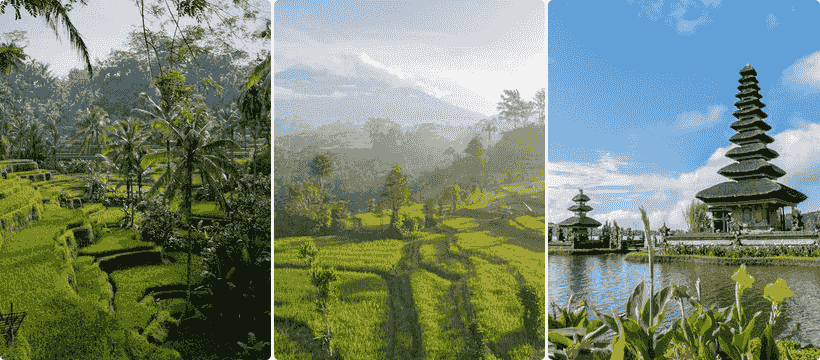
1. Which Area to Base Yourself
Bali has no single centre. It is a collection of distinct zones spread across a large island, each with a completely different atmosphere, infrastructure and price level. Choosing your base is the single most important travel decision you'll make — it determines your daily costs, access to attractions and the type of experience you'll have.
Based on 900+ accommodation reviews filtered to 8.5+ ratings on Booking.com and Google Maps, here is how the major areas compare:
| Area |
Best For |
Avg. Mid-Range Villa / Hotel |
Getting Around |
Verdict |
| Ubud |
Culture, yoga, rice terraces, jungle |
$45–$120 / night |
Scooter or Grab — no walk anywhere |
Best for Culture |
| Seminyak |
Beaches, restaurants, boutiques |
$60–$180 / night |
Walk the strip, Grab for further trips |
Best All-Round |
| Canggu |
Surf, digital nomads, cafés, nightlife |
$40–$130 / night |
Scooter essential, Grab available |
Best for Surfers |
| Nusa Dua |
Families, luxury resorts, calm water |
$80–$300 / night |
Resort shuttle or Grab |
Luxury / Family |
| Uluwatu |
Clifftop views, surf, sunsets |
$50–$160 / night |
Scooter essential — very spread out |
Best Sunsets |
Research verdict: First-time visitors to Bali are typically best served by a split base — 3–4 nights in Ubud (culture, temples, rice terraces) followed by 4–5 nights in Seminyak or Canggu (beach, restaurants, nightlife). This covers the island's two distinct personalities without requiring long daily drives.
"
Ubud in the mornings before the tour groups arrive is genuinely magical. I spent three days doing nothing but walking to temples, eating at warungs for Rp 30,000 a meal, and watching the rice fields change colour at golden hour. Then Seminyak for the evenings — completely different vibe, both essential.
— TripAdvisor user NomadFromMelbourne, Bali review (verified stay, March 2026)
2. 7-Day Bali Itinerary
This itinerary divides the island into logical zones to minimise daily driving time. Days 1–3 cover Ubud and the cultural interior. Days 4–7 move to the southern coast and the Nusa islands. All transport notes and entry prices are included.
Tegallalang Rice Terraces
Arrive before 9am to beat the tour groups. The UNESCO-listed terraced rice paddies north of Ubud are at their most photogenic in the morning light. Walk the lower paths between rice fields — the paid Instagram swings along the upper ridge are entirely optional and overpriced.
💡 Entry: Rp 15,000. Hire a driver from Ubud for ~Rp 150,000 return (~25 min each way).
Ubud Monkey Forest
Three Hindu temples set inside a dense forest inhabited by 700+ long-tailed macaques. Wear a sarong (required, provided at entrance), keep bags closed and do not feed the monkeys. The mossy stonework and towering fig trees are genuinely impressive. Allow 1–1.5 hours.
💡 Entry: Rp 80,000. Keep phones in pockets — monkeys have learned to snatch them.
Ubud Art Market & Ubud Palace
Walk the main Ubud market for batik fabrics, silver jewellery and carved wooden goods — prices are negotiable. Ubud Royal Palace opposite is free to enter and hosts Kecak fire dance performances at 19:30 on selected evenings.
💡 Kecak dance: Rp 100,000. Book early — performances sell out by mid-afternoon.
Tirta Empul Holy Spring Temple
One of Bali's most sacred temples, built around natural spring pools where Balinese Hindus perform purification rituals. Arrive before 8am to observe the ritual in relative quiet. Participation by visitors is possible but respectful observation is equally acceptable.
🛵 Driver from Ubud: ~25 min, ~Rp 150,000 return
💡 Entry: Rp 50,000. Sarong required (provided). Avoid visiting during major Hindu ceremonies.
Kanto Lampo Waterfall
A lesser-known stepped waterfall 15 minutes east of Ubud that flows directly over mossy volcanic rock formations. Far less crowded than Tegenungan. The descent to the base involves steep steps — wear appropriate footwear.
💡 Entry: Rp 20,000. Best flow during the wet season but accessible year-round.
Balinese Cooking Class
Most Ubud cooking classes begin with a morning market visit to select ingredients, then teach 6–8 dishes including satay, tempeh and black rice pudding. Recommended providers (Google Maps 4.5+, 200+ reviews): Paon Bali and Casa Luna. Duration: 4–5 hours including a full meal.
💡 Price: Rp 350,000–550,000 per person. Book 1–2 days in advance.
Mount Batur Sunrise Trek
The 1,717m active volcano north of Ubud is Bali's most popular trek. The 2-hour ascent begins before dawn, reaching the summit for sunrise over the crater lake and Mount Agung. No technical skill required. Licensed guides are mandatory (Rp 450,000–600,000 including guide and breakfast at the summit). Book through your accommodation the evening before.
🛵 Guided tour with hotel pickup — departure 02:00, ~1.5 hr drive to trailhead
💡 Bring a headtorch, warm layer and waterproof shoes. Descend by 09:00 before the heat peaks.
Transfer to Seminyak or Canggu
After returning from the volcano and resting, travel south to your coastal base. Grab from Ubud to Seminyak takes approximately 1.5 hours. Many hotels offer private transfers; ask at reception for current rates.
📱 Grab from Ubud to Seminyak — ~1.5 hr, Rp 120,000–180,000
Nusa Penida: Kelingking, Angel's Billabong & Broken Beach
The island southeast of Bali offers the dramatic clifftop viewpoints that define Bali's visual identity. The T-Rex cliff at Kelingking Beach, the natural infinity pool at Angel's Billabong and the natural arch at Broken Beach are all within 20 minutes of each other. Fast boat from Sanur harbour takes 45 minutes.
⛵ Fast boat from Sanur to Nusa Penida — 45 min, Rp 150,000–200,000 each way
💡 Book fast boat in advance during peak season (Jul–Aug). Roads on Nusa Penida are rough — hire a scooter (Rp 80,000/day) or join a day tour (Rp 350,000–500,000 all-in).
Seminyak Beach, Restaurant Row & Evening
Seminyak Beach is one of Bali's best — long, less crowded than Kuta, and lined with beachfront restaurants. La Lucciola (Google Maps 4.3+, 1,800+ reviews) for sunset drinks; Métis for upmarket Indonesian-French fusion (book in advance). End the evening at Ku De Ta or La Favela for Bali's bar scene.
💡 Budget dinner at a warung: Rp 40,000–80,000. Sunset cocktails at beachfront bar: Rp 120,000–200,000 per drink.
Uluwatu Temple Sunset & Kecak Dance (Day 6)
The most dramatically situated of Bali's major temples — perched on a 70m cliff above the Indian Ocean. Best visited in the late afternoon to stay for the sunset Kecak fire dance performed on an ocean-view stage at 18:00. The cliff walk between temple gates offers panoramic views and is free to explore.
📱 Grab from Seminyak to Uluwatu — ~45 min, Rp 80,000–120,000
💡 Entry: Rp 50,000. Kecak dance: Rp 150,000. Sarong required. Watch belongings — monkeys here snatch sunglasses.
Tanah Lot Temple at Sunset (Day 7)
Bali's most photographed sea temple sits on a rocky islet accessible on foot at low tide. The view of the temple silhouetted against an orange sunset is genuinely spectacular. Arrive 1 hour before sunset to secure a viewpoint position.
📱 Grab from Seminyak to Tanah Lot — ~45 min, Rp 100,000–140,000
💡 Entry: Rp 60,000. Tide chart at entrance — aim for mid to low tide for best access.
Extension option: If you have 10+ days, add 2 nights on Gili Trawangan (fast boat from Padang Bai, ~2 hours, Rp 250,000–400,000). The Gili islands offer crystal-clear snorkelling, no motorised vehicles and dramatically lower prices than Bali's coastal resorts.
3. Getting Around Bali
Bali has no public transport network. Getting around means choosing between Grab, private drivers, scooters and metered taxis. The right choice depends on your confidence, destination and group size.
Grab (Ride-Hailing)
Grab is the most practical option for most tourists. Fixed prices, air-conditioned cars and no negotiation. Note: Grab is restricted in certain tourist zones (Kuta, Nusa Dua) due to local taxi pressure — walk two minutes off the main strip before booking to avoid rejected pickups.
✅
Grab Car: Best for longer journeys, families or luggage. Seminyak to Ubud costs Rp 120,000–180,000 (~1.5 hours). Book via the Grab app.
✅
Grab Bike: Fastest for short trips within Seminyak, Canggu or Ubud. Rp 8,000–25,000 for most local journeys.
✅
Private driver (full day): Rp 500,000–700,000 for an 8–10 hour hire covering multiple stops. Excellent value for temple-heavy days visiting 4–6 sites. Book through your accommodation.
⚠️
Scooter rental: Rp 60,000–100,000/day. Only recommended for experienced riders — Bali roads are busy, road rules are loosely enforced and accident rates among tourists are high. An International Driving Permit (motorcycle category) is required.
❌
Metered taxis: Blue Bird is the only reliable licensed metered taxi. Avoid unlicensed taxis that approach you at tourist sites — always use Grab or Blue Bird to confirm the fare before entering.
"
Grab changed everything for us in Bali. We spent 10 days covering the whole island — Ubud to Uluwatu, Seminyak to Sanur — without renting a scooter and without getting ripped off once. Fixed prices, the drivers were great, and it always showed up in under 10 minutes.
— Google Maps user A.Petersson, Bali transport review (verified, February 2026)
4. Practical Info: Money, SIM & Safety
Money & Payments
💵
Bali is still heavily cash-dependent outside mid-range and upmarket establishments. Street food, local warungs, temples and markets require cash. Always carry Rp 200,000–500,000.
🏧
ATMs: BCA and Mandiri ATMs accept most international cards with Rp 25,000–50,000 transaction fees. Avoid non-bank branded ATMs near tourist sites — these charge excessive fees and can skim card data.
💱
Currency exchange: Some Kuta money changers use rigged counting methods. Always count your notes before leaving the counter. ATM withdrawals (BCA/Mandiri) are generally safer for amounts under Rp 2,000,000.
💳
Visa and Mastercard accepted at hotels, mid-range restaurants and larger shops. Some establishments add a 2–3% surcharge for card payments.
SIM Cards
📶
Telkomsel (SimPATI) or XL Axiata: Both available at the airport and across tourist areas. Telkomsel has stronger rural coverage (useful for temple routes north of Ubud). 10GB for 30 days costs Rp 75,000–100,000.
📶
Registration required: Indonesian SIMs require passport registration at point of sale. Bring your passport. Unregistered SIMs stop working within days of purchase.
Safety
Bali is very safe for tourists. The main risks are traffic accidents (scooters), petty theft in crowded areas and beach undertows on surf beaches. The money-changer counting scam is the most common tourist fraud — use BCA/Mandiri ATMs whenever possible.
☀️
Sun and heat: UV levels in Bali are extreme — SPF 50+ recommended daily. Drink 2–3 litres of water, especially during temple walks and treks.
🏥
Medical: BIMC Hospital (Kuta and Nusa Dua) and Siloam Hospitals Bali are internationally recognised with English-speaking staff. Travel insurance with evacuation cover is strongly recommended.
🛕
Temple etiquette: A sarong and sash are required at all Balinese Hindu temples — provided at entrances (free or small donation). Respectful behaviour is expected; avoid turning your back on altars or touching offerings.
5. Best Time to Visit Bali
Based on climate data from BMKG (Indonesia's Meteorological Agency) and seasonal review patterns, here is a clear breakdown. Bali's seasons are less extreme than mainland Southeast Asia — the island is tropical year-round with warm temperatures.
| Season |
Months |
Weather |
Crowds |
Verdict |
| 🌞 Dry Season |
Apr – Oct |
26–32°C, low humidity, sunny |
High (Jul–Aug peak) |
Best Overall |
| 🌥️ Shoulder |
Apr / Sep–Oct |
27–31°C, occasional showers |
Moderate |
Best Value |
| 🌧️ Wet Season |
Nov – Mar |
26–30°C, afternoon rain daily |
Low (Dec–Jan holiday spike) |
Cheapest Rates |
| 🎉 Nyepi |
Mar (variable) |
Variable |
Very Low |
Balinese New Year — full island silence day |
Note on the wet season: Bali's rainy season differs from mainland Southeast Asia. Rain typically falls as short, heavy afternoon downpours (1–2 hours) rather than all-day grey drizzle. Mornings are usually clear and sunny. Villa and hotel rates drop 25–40% in the wet season — a reasonable trade-off for travellers focused on culture and food rather than beach activities.
Frequently Asked Questions
How much does a taxi from Bali airport to Seminyak cost?
An official airport taxi from Ngurah Rai Airport (DPS) to Seminyak costs IDR 150,000–200,000 (US$9–12). The fixed-rate taxi counter in the arrivals hall is the safest option — pay upfront, get a voucher, hand it to the driver. Ride-hailing apps like Grab and Gojek charge IDR 80,000–180,000 but require walking to the designated pickup zone outside the terminal. Distance: 10–13 km, taking 20–50 minutes depending on traffic. Avoid unofficial touts approaching you outside the taxi zone who typically quote inflated prices.
Do I need an international driving permit to rent a scooter in Bali?
Yes — an International Driving Permit (IDP) with a motorcycle endorsement (Class A) is legally required to ride a scooter in Bali. A car-only IDP (Class B) is not valid for scooters. You must carry both the physical IDP booklet and your home country motorcycle licence — digital copies are not accepted at police checkpoints. Police checkpoints in tourist areas like Canggu and Ubud actively enforce this. Riding without a valid licence carries a fine of up to IDR 1,000,000 (US$60–70). More critically, if you have an accident without proper documentation, your travel insurance will almost certainly deny your claim, leaving you personally liable for medical costs including evacuation. Get your IDP before leaving your home country — it cannot be obtained after arriving in Indonesia.
Cash or card in Bali — how much cash should I carry?
Cash is still essential for most day-to-day transactions in Bali: local warungs and street food, markets and souvenir stalls, scooter rental, temple and waterfall entrance fees, parking fees, and tips. Cards work at hotels, larger restaurants, beach clubs, and supermarkets (often with a 2–3% surcharge). For a one-week trip, bring IDR 2,000,000–3,000,000 (US$120–190) in cash — carry only what you need for the day and lock the rest in your hotel safe. Small notes (IDR 20,000 and 50,000) are crucial for everyday purchases; IDR 100,000 notes can be hard to break at small warungs. Use a Wise or Revolut card for larger purchases and ATM withdrawals — BCA and BNI ATMs are the most reliable for foreign cards.
Is Bali belly still common and how do I avoid it?
Yes, Bali belly remains common in 2026 — it is the most reported health issue among travellers to Bali. The golden rule: boil it, cook it, peel it, or forget it. Avoid tap water (even for brushing teeth), ice from unknown sources, raw salads and unpeeled fruits, buffet food left sitting at room temperature, and street food from stalls with low turnover. Stick to freshly cooked piping-hot dishes, bottled or boiled water, and fruits you peel yourself (bananas, mangoes). Pack oral rehydration salts (ORS), hand sanitiser (60%+ alcohol), and probiotics (start before your trip). If you do get sick, hydrate aggressively with ORS and seek medical help if symptoms last beyond 48 hours or include severe fever or bloody stools.
Ubud or Seminyak — where should I stay in Bali?
It depends on what you want.
Seminyak is the beach-and-nightlife base: beach clubs (Potato Head, Ku De Ta), sunset bars, upscale restaurants, boutiques, and surfing at Double Six Beach.
Ubud is the cultural-and-nature base: rice terraces, yoga studios, temples, waterfalls, and the Monkey Forest — about 90 minutes inland from the airport. The ideal one-week Bali split: 2–3 nights in Seminyak for beach and sundowners, then 3–4 nights in Ubud for culture and relaxation. For a deeper area-by-area breakdown with specific hotel picks, see our
Bali areas comparison guide.